
As an Amazon Associate, we earn from qualifying purchases.
Whole wheat bread is healthier and more flavorful than white bread, but it’s also harder on a bread machine. The dough is heavier, the bran slows down gluten development, and a weak machine can leave you with a short, dense brick.
To find the best bread machine for whole wheat bread, we compared manufacturer specs and manuals, published recipes from trusted baking sources, and patterns in verified buyer reviews from people who bake whole grain loaves every week.
Our quick picks:
- Best overall: Zojirushi Home Bakery Virtuoso Plus
- Best for large families: West Bend 3-lb Hi-Rise
- Best budget pick: Elite Gourmet EBM8103
Quick Comparison: Best Whole Wheat Bread Machines
| Model | Best for | Whole wheat settings | Paddles | Max loaf | Price |
|---|---|---|---|---|---|
| Zojirushi Virtuoso Plus (BB-PDC20) | Best overall | Whole Wheat, Rapid Whole Wheat, Multigrain | 2 | 2 lb | Check price |
| Breville Custom Loaf (BBM800XL) | Seeded loaves | Whole Wheat (with preheat), Custom | 1 (collapsible) | 2.5 lb | Check price |
| West Bend Hi-Rise (47413) | Large families | Wheat | 2 | 3 lb | Check price |
| Cuisinart Convection (CBK-210) | Better crust | Whole Wheat | 1 | 2 lb | Check price |
| KITCHENARM 29-in-1 SMART | Most programs | Whole Wheat, Multigrain, Homemade | 1 | 2 lb | Check price |
| Elite Gourmet EBM8103 | Budget | Whole Wheat | 1 | 2 lb | Check price |
Why Whole Wheat Bread Is Harder for a Bread Machine
Whole wheat flour contains the whole grain: the bran, the germ, and the endosperm. That’s great for fiber and flavor. But the sharp bits of bran cut through the gluten strands as the dough develops, and the bran soaks up a lot of water. The result is a heavier dough that rises more slowly.
A good whole wheat cycle handles this in three ways:
- A rest or “preheat” phase before kneading, so the bran has time to absorb water and soften
- Longer kneading, to build enough gluten in a heavy dough
- Longer rise times, so the loaf can reach full height before baking
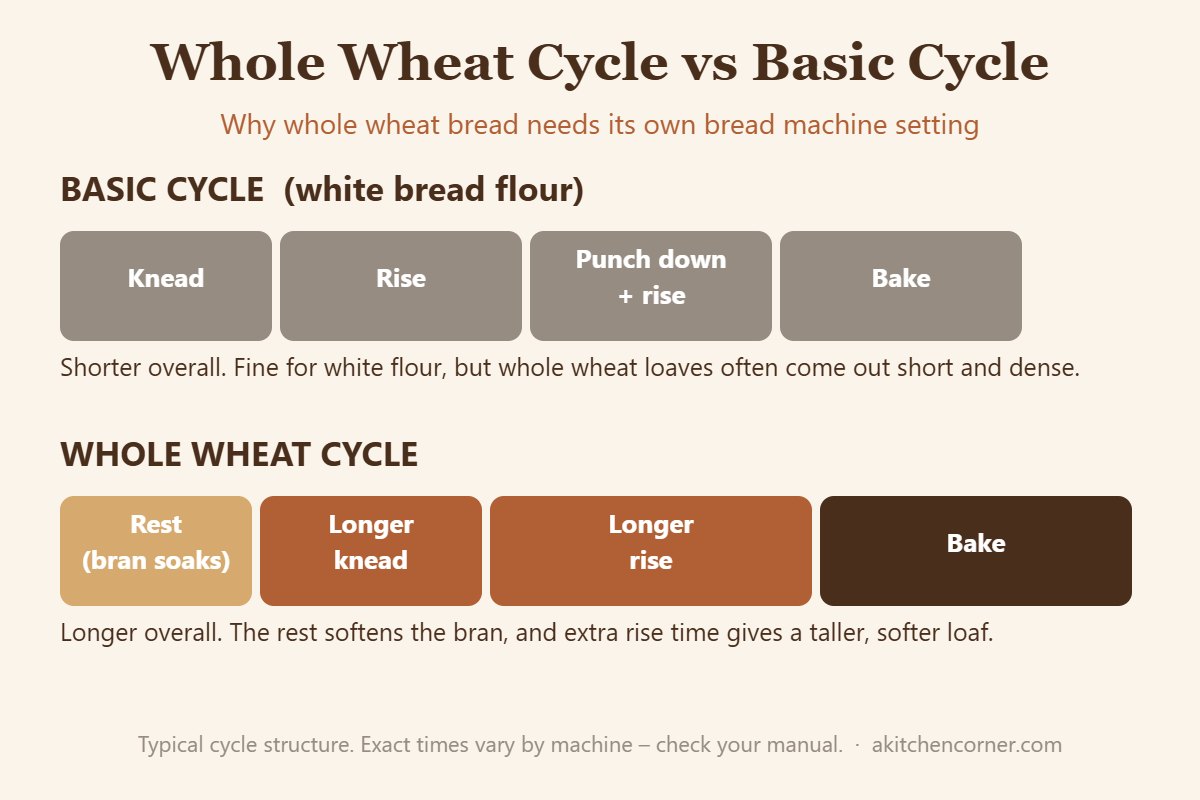
That’s why a dedicated whole wheat setting usually runs longer than the basic cycle. If you bake 100% whole wheat bread on a basic cycle, you’ll often get a shorter, denser loaf.
Heavy dough also puts more strain on the machine. A sturdy motor and a solid paddle matter more here than for white bread. Two paddles in a horizontal pan help too, because they mix stiff dough evenly from end to end.
How We Chose These Machines
We haven’t run lab tests on every machine on this list. Instead, we built it from:
- Manufacturer specs and manuals, to confirm what each whole wheat cycle includes
- Recipes and guidance from trusted baking sources, like King Arthur Baking
- Patterns in verified buyer reviews, focused on people who bake whole wheat and multigrain loaves often
- Our own in-depth reviews of several of these brands on A Kitchen Corner
We scored each machine on:
- A dedicated whole wheat (and ideally multigrain) cycle
- Motor strength and how well it handles heavy dough
- Pan shape and number of paddles
- Custom programming for fine-tuning
- Loaf size, ease of cleaning, and overall value
Where a detail still needs checking, we say so rather than guess.
The 6 Best Bread Machines for Whole Wheat Bread
1. Zojirushi Home Bakery Virtuoso Plus (BB-PDC20) – Best Overall
If you bake whole wheat bread several times a week, the Virtuoso Plus is the machine many serious home bakers recommend first. It has not one but three whole grain options: Whole Wheat, Rapid Whole Wheat, and Multigrain. The Multigrain course is designed for blends of whole grain flours with seeds and nuts.
Why it works for whole wheat:
- Two kneading blades in a horizontal pan, so heavy dough mixes evenly with no dry corners
- Heating elements in both the lid and the base, for more even baking and browning
- Homemade memory settings, so you can save your own knead, rise, and bake times
- A 700-watt rating, one of the strongest in this group
Pros
- Dedicated Whole Wheat, Rapid Whole Wheat, and Multigrain courses
- Classic rectangular loaf that slices well for sandwiches
- Custom cycles for 100% whole wheat recipes
- Strong reputation for build quality and long life
Cons
- One of the most expensive bread machines you can buy
- Large footprint (about 18 x 10.5 x 13 inches)
- Some owners say the default whole wheat course needs a little recipe tweaking to get a tall loaf
Best for: Daily whole wheat bakers who want one machine that will last for years.
Curious about other Zojirushi models, like the compact Mini? See our Zojirushi bread maker review.
2. Breville Custom Loaf (BBM800XL) – Best for Seeded and Multigrain Loaves
If you like whole wheat bread with seeds, nuts, or dried fruit, the Breville Custom Loaf is built for it. Its Whole Wheat setting is designed for breads with more than 50% whole wheat, whole grain, or specialty flour, and it includes a preheat phase to give the yeast a head start. An automatic fruit and nut dispenser drops your add-ins at the right moment, so you don’t have to wait around for the beep.
Why it works for whole wheat:
- A dedicated Whole Wheat setting with a preheat phase, for a lighter, higher loaf
- A collapsible paddle that folds down before baking, leaving a much smaller hole in the bottom of the loaf
- Custom programs you can save, with manual control over each phase
- Four loaf sizes, from 1 lb up to a 2.5-lb family loaf
Pros
- The automatic dispenser makes seeded whole grain loaves truly hands-off
- Smaller paddle hole than most single-paddle machines
- Flexible custom programming for 100% whole wheat recipes
- Known for quiet operation
Cons
- Expensive, close to premium pricing
- A large machine
- Sticky add-ins can occasionally jam the dispenser, so don’t overfill it
Best for: Bakers who love multigrain and seeded whole wheat bread and want the machine to handle the add-ins.
Read our full Breville bread maker review of the BBM800XL.
3. West Bend Hi-Rise (47413) – Best for Large Families
Whole wheat bread disappears fast in a busy home. The West Bend Hi-Rise lets you bake a 2-lb, 2.5-lb, or 3-lb loaf in a horizontal pan with two kneading blades, which is rare at this price.
Why it works for whole wheat:
- A dedicated Wheat setting among 12 programs
- Dual paddles to handle heavy dough
- A 750-watt rating for big batches
- A custom setting for your own knead and rise times
Pros
- Very large capacity for the price
- Horizontal loaf shape
- Up to 13-hour delay timer, so you can wake up to fresh bread
- Gluten-free and dough settings included
Cons
- A large machine that needs plenty of counter space
- Fewer whole grain options than the Zojirushi (no separate multigrain course)
- Some buyers report the paddles can stick in the loaf
Best for: Families who go through a lot of sandwich bread every week.
We cover a similar West Bend dual-paddle machine, with a custom menu and loaf sizes from 1.5 to 3 lb, in our West Bend bread maker review.
4. Cuisinart Convection Bread Maker (CBK-210) – Best for a Better Crust
The Cuisinart CBK-210 adds a convection fan that circulates hot air during baking. For whole wheat bread, that can mean a more even bake and a crisper crust, which helps with heavy loaves that tend to stay pale or soft on the sides.
Why it works for whole wheat:
- A dedicated Whole Wheat setting
- Convection baking for more even browning
- Three loaf sizes, up to 2 lb
Pros
- Convection gives better crust color and texture
- Well-known brand with easy-to-find replacement parts
- Clear controls that suit beginners
Cons
- Single paddle in a vertical pan
- Bulkier than Cuisinart’s compact CBK-110
- Convection can make the crust a bit thicker than some people like
Best for: Bakers who want a golden, crunchy crust on their whole wheat loaves.
We compare the compact and convection models side by side in our Cuisinart bread maker review.
5. KITCHENARM 29-in-1 SMART – Most Programs
If you like to experiment, the KITCHENARM 29-in-1 gives you plenty to play with. Its menus include whole wheat and multigrain, plus a homemade (custom) menu where you set your own knead, rise, and bake times. That custom menu is the key feature here. It lets you add a longer rest or rise for 100% whole wheat recipes.
Why it works for whole wheat:
- Whole wheat and multigrain menus
- A custom homemade menu for fine-tuning
- Built-in recipe guidance for beginners
Pros
- Very flexible programming
- Mid-range price for this many features
- Up to a 2-lb loaf
Cons
- So many menus can feel overwhelming at first
- Single paddle, so scrape the pan corners during the first few minutes
- Some buyers find the first whole wheat loaves a little dense until they adjust the recipe
Best for: Curious bakers who want to try many kinds of whole grain bread.
Read our KITCHENARM bread maker review.
6. Elite Gourmet EBM8103 – Best Budget Pick
You don’t need to spend a lot to bake decent whole wheat bread. The Elite Gourmet EBM8103 includes a Whole Wheat setting, three loaf sizes up to 2 lb, and three crust settings at an entry-level price. Buyer feedback on whole wheat loaves is generally positive, especially when bakers add a little vital wheat gluten.
Why it works for whole wheat:
- A dedicated Whole Wheat program
- Simple controls with a short learning curve
- Low cost, so it’s an easy way to start
Pros
- Very affordable
- Compact and easy to store
- Handles basic whole wheat and half-and-half loaves well
Cons
- Less power for 100% whole wheat dough than premium machines
- Single paddle in a vertical pan
- Fewer custom options
Best for: Beginners and occasional whole wheat bakers on a tight budget.
See our Elite Gourmet bread maker review, where we compare the EBM8103B and EBM8103SS. For more low-cost machines, check our list of the best bread machines under $100.
Buying Guide: How to Choose a Bread Machine for Whole Wheat Bread
A dedicated whole wheat cycle
This is the most important feature. Look for a Whole Wheat or Whole Grain setting, not just “Basic”. A true whole wheat cycle adds a rest phase and longer rise times. A Multigrain course is a bonus if you like seeded breads.
Motor strength and build
Heavy whole wheat dough makes the motor work harder. Wattage isn’t a perfect measure of kneading power, but sturdy machines in the 600- to 750-watt range tend to handle stiff dough with less strain. If a machine “walks” across the counter or struggles during kneading, the dough is too heavy for it.
Pan shape and number of paddles
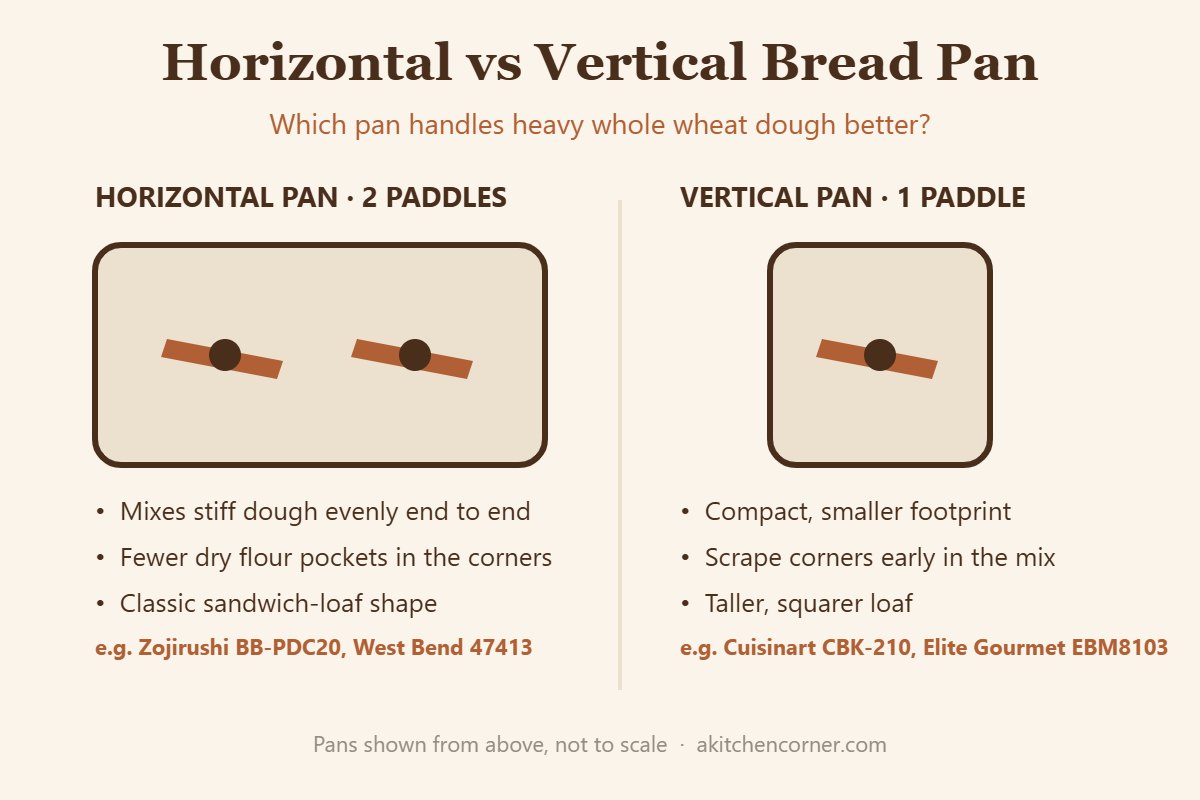
Horizontal pans with two paddles, like the Zojirushi and West Bend, mix heavy dough evenly and bake a classic sandwich loaf. Vertical pans with one paddle are common on cheaper machines. They work fine, but you may need to scrape the corners with a spatula early in the mix.
Custom programming
A custom or homemade program lets you add a longer rest or a longer rise. That’s often the secret to a taller 100% whole wheat loaf. It also lets you fix a preset that doesn’t suit your recipe.
Loaf size
Most households do well with a 1.5- to 2-lb loaf. If you bake for a big family, a 3-lb machine like the West Bend saves time. Keep in mind that whole wheat bread made without preservatives goes stale faster, so only bake what you’ll eat in a few days, or freeze the extra slices.
Delay timer and keep-warm
A delay timer lets you load ingredients at night and wake up to fresh bread. If you use it, avoid recipes with milk, eggs, or other perishable ingredients.
Tips for Softer, Taller Whole Wheat Bread in a Bread Machine
- Use the whole wheat cycle. It gives the bran time to soften and the dough time to rise.
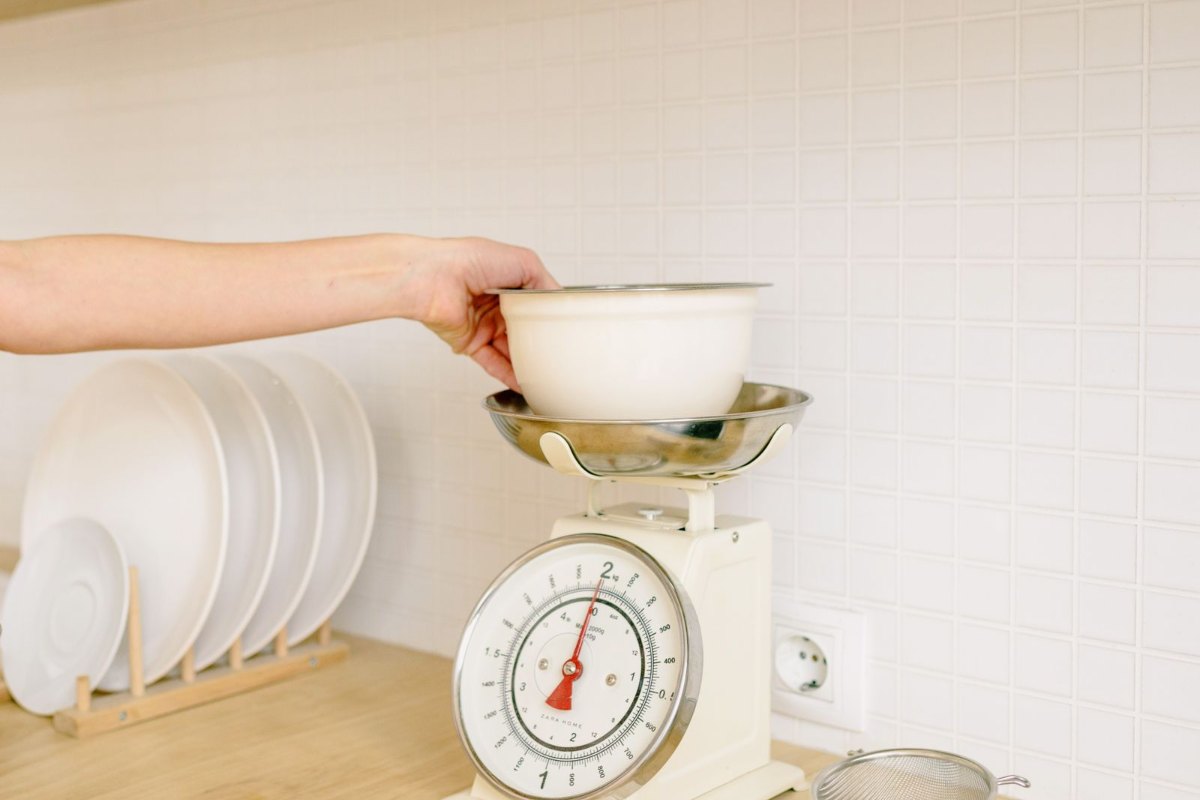
- Weigh your flour. Whole wheat flour packs down easily, so cups are often too heavy. A digital scale gives far more consistent loaves.
- Add vital wheat gluten. A small amount boosts rise and softness in 100% whole wheat bread. You don’t need much: King Arthur’s 100% whole wheat bread machine recipe uses an optional 1 tablespoon with 3½ cups of whole wheat flour. Always follow your recipe.
- Try white whole wheat flour. It’s still 100% whole grain but made from a lighter wheat, so the flavor is milder and the loaf looks lighter.
- Add a little more liquid. Bran absorbs water. Check the dough a few minutes into kneading. It should form a soft, slightly tacky ball. Add a teaspoon of water at a time if it looks dry and crumbly.
- Sweeten slightly. A spoonful of honey or molasses softens the flavor of whole wheat and helps the yeast.
- Store whole wheat flour in the fridge or freezer. The germ contains natural oils that can go rancid at room temperature.
- Let the loaf cool before slicing. Cutting warm bread squashes the crumb and makes it gummy.
Why is my whole wheat bread dense in the bread machine?
The most common causes are:
- Using the basic cycle instead of the whole wheat cycle
- Too much flour from scooping with measuring cups
- Dough that’s too dry for the bran to soften
- Old or weak yeast
- A recipe with 100% whole wheat flour and no extra gluten
Fix one thing at a time, starting with weighing your flour and using the right cycle.
Half whole wheat vs 100% whole wheat
If you’re new to whole wheat baking, start with a 50/50 blend of whole wheat flour and bread flour. It rises more easily and still has plenty of nutty flavor. Once you know your machine, move toward 100% whole wheat with a little vital wheat gluten.
If you also want to make pizza crust from whole wheat flour, our guide to the best bread machines for pizza dough covers machines with strong dough cycles.
FAQ
What is the best bread machine for whole wheat bread?
For most people, the Zojirushi Home Bakery Virtuoso Plus (BB-PDC20) is the best bread machine for whole wheat bread. It has dedicated Whole Wheat, Rapid Whole Wheat, and Multigrain courses, two kneading blades, and custom memory settings. For a lower price, the Elite Gourmet EBM8103 is a good budget choice, and the West Bend Hi-Rise is great for large families.
Can you make 100% whole wheat bread in a bread machine?
Yes. Use the whole wheat cycle, weigh your flour, and make sure the dough is slightly tacky. Many bakers also add vital wheat gluten for a taller, softer loaf. A machine with a custom program gives you even more control.
What is the difference between the whole wheat and basic cycle?
The whole wheat cycle is longer. It usually includes a rest or preheat phase so the bran can absorb water, plus longer kneading and rise times. The basic cycle is designed for white bread flour, so whole wheat loaves made on it often come out shorter and denser.
Do I need vital wheat gluten for whole wheat bread in a bread machine?
Not always. A 50/50 blend of whole wheat and bread flour usually rises well without it. For 100% whole wheat bread, a little vital wheat gluten often makes a noticeable difference in height and softness.
Can I use whole wheat flour in place of bread flour in any recipe?
You can, but the loaf will be denser if you swap it one-for-one. Whole wheat flour absorbs more water and has less gluten-forming strength. Start by replacing about half the bread flour, add a little more liquid, and use the whole wheat cycle.
Is a bread machine with two paddles better for whole wheat?
Two paddles in a horizontal pan mix heavy whole wheat dough more evenly and bake a traditional loaf shape. Single-paddle machines can still make good whole wheat bread. You may just need to scrape the corners during the first few minutes of kneading.
Final Verdict
The best bread machine for whole wheat bread is the one that gives heavy dough the time and power it needs: a real whole wheat cycle, a sturdy motor, and even kneading.
- Best overall: Zojirushi Home Bakery Virtuoso Plus, for three whole grain courses, dual paddles, and custom cycles
- Best for large families: West Bend Hi-Rise, with a 3-lb capacity and dual paddles
- Best budget pick: Elite Gourmet EBM8103, a simple and affordable way to start
If whole wheat bread is a daily habit in your home and you can stretch your budget, the Zojirushi is the one we’d choose. Baking gluten-free too? See our guide to the best bread machine for gluten free bread.
Leave a Reply